





FAST TRACT IT SERVICE L.L.C proudly presents an in-depth look at how enterprise cloud infrastructure is transforming in 2026 and what organizations must do to remain competitive in a rapidly evolving digital economy.
Enterprise cloud infrastructure has become the backbone of modern business operations. As we move deeper into 2026, organizations across industries are redefining how they deploy, manage, secure, and optimize cloud environments. The future is no longer about simply migrating workloads to the cloud—it is about building intelligent, scalable, secure, and cost-efficient cloud ecosystems that drive innovation and resilience.
In this comprehensive guide, we explore the trends, technologies, and strategic shifts shaping enterprise cloud infrastructure in 2026 and beyond.
The Evolution of Enterprise Cloud Infrastructure
Over the past decade, enterprise cloud infrastructure has evolved from basic Infrastructure-as-a-Service (IaaS) models to complex, hybrid, and multi-cloud ecosystems. In 2026, the cloud is no longer just a hosting environment—it is the operational core of the enterprise.
From Centralized Data Centers to Distributed Cloud
Traditional on-premises data centers are rapidly being replaced by distributed cloud models. Enterprises now operate across:
- Public clouds
- Private clouds
- Hybrid environments
- Edge computing locations
This distributed approach enables better performance, lower latency, and increased flexibility. Instead of relying on a single centralized data center, organizations leverage geographically dispersed cloud resources to meet business demands in real time.
Cloud as a Strategic Business Enabler
In 2026, enterprise cloud infrastructure is directly tied to business outcomes. Cloud strategies now influence:
- Product innovation cycles
- Customer experience
- Global expansion
- Operational resilience
Companies no longer view cloud adoption as an IT decision alone—it is a board-level priority.
Key Trends Shaping Enterprise Cloud Infrastructure in 2026
Several transformative trends are defining how enterprises approach cloud infrastructure this year.
1. Multi-Cloud as the Standard Architecture
Multi-cloud is no longer optional. Organizations use multiple cloud providers to:
- Avoid vendor lock-in
- Optimize costs
- Improve redundancy
- Access specialized services
Modern enterprise cloud infrastructure strategies integrate AWS, Microsoft Azure, Google Cloud, and niche providers into unified management platforms.
Unified Cloud Management Platforms
To control complexity, businesses are adopting centralized cloud management solutions that provide:
- Real-time visibility
- Cost analytics
- Security monitoring
- Automated provisioning
These tools help enterprises maintain governance across diverse cloud ecosystems.
2. AI-Driven Cloud Operations (AIOps)
Artificial intelligence is revolutionizing enterprise cloud infrastructure management.
AIOps platforms analyze vast datasets to:
- Detect anomalies
- Predict failures
- Optimize performance
- Automate incident response
In 2026, predictive maintenance and automated scaling are standard features of advanced cloud environments.
Self-Healing Infrastructure
One of the most exciting advancements is self-healing infrastructure. Systems can now:
- Identify potential service disruptions
- Automatically reroute traffic
- Spin up replacement resources
- Resolve configuration issues
This reduces downtime and enhances business continuity.

3. Edge Computing Integration
The rise of IoT, 5G, and real-time analytics has accelerated the adoption of edge computing.
Enterprise cloud infrastructure in 2026 seamlessly integrates edge nodes with centralized cloud systems. This enables:
- Ultra-low latency processing
- Faster data analysis
- Improved user experiences
Industries such as healthcare, manufacturing, and retail particularly benefit from edge-enabled cloud solutions.
Security and Compliance in Modern Enterprise Cloud Infrastructure
Security remains one of the most critical aspects of enterprise cloud infrastructure.
Zero Trust Architecture
Zero Trust is now the default security model. Instead of assuming internal traffic is safe, Zero Trust principles require:
- Continuous identity verification
- Least-privilege access
- Micro-segmentation
- Real-time monitoring
This approach significantly reduces attack surfaces.

Cloud-Native Security Tools
Traditional security tools are insufficient in dynamic cloud environments. In 2026, enterprises rely on:
- Cloud workload protection platforms (CWPP)
- Cloud security posture management (CSPM)
- Container security solutions
- DevSecOps pipelines
Security is integrated directly into development and deployment workflows.
Sustainability and Green Cloud Initiatives
Environmental responsibility is increasingly influencing enterprise cloud infrastructure decisions.
Carbon-Aware Cloud Deployment
Enterprises now evaluate cloud providers based on:
- Renewable energy usage
- Energy-efficient data centers
- Carbon footprint transparency
Cloud vendors are investing heavily in green energy initiatives, and organizations are aligning with sustainability goals.
Optimized Resource Consumption
Advanced resource monitoring helps businesses:
- Reduce idle compute instances
- Optimize storage allocation
- Automate shutdown of unused environments
Sustainability and cost optimization now go hand in hand.
Automation and Infrastructure as Code (IaC)
Automation is a foundational element of enterprise cloud infrastructure in 2026.
Infrastructure as Code Maturity
Infrastructure as Code allows enterprises to:
- Provision environments rapidly
- Ensure configuration consistency
- Reduce human error
- Accelerate deployment cycles
Tools like Terraform and CloudFormation are deeply integrated into DevOps workflows.
Continuous Delivery and Cloud Agility
Cloud infrastructure is now built for agility. Organizations use CI/CD pipelines to deploy updates multiple times per day, enabling:
- Faster innovation
- Improved reliability
- Reduced downtime
Automation has transformed infrastructure from static to dynamic.

Cost Optimization in Enterprise Cloud Infrastructure
Cloud spending continues to grow, making cost management a top priority.
FinOps as a Core Practice
Financial Operations (FinOps) brings finance, IT, and operations teams together to:
- Monitor usage in real time
- Identify waste
- Forecast cloud expenses
- Align spending with business goals
FinOps ensures enterprise cloud infrastructure investments generate measurable ROI.
Effective cloud cost optimization strategies for business leaders help maintain financial discipline while scaling infrastructure.
Intelligent Workload Placement
AI-powered analytics determine the most cost-efficient placement of workloads across:
- Public clouds
- Private environments
- Edge locations
This dynamic optimization reduces unnecessary expenditure.
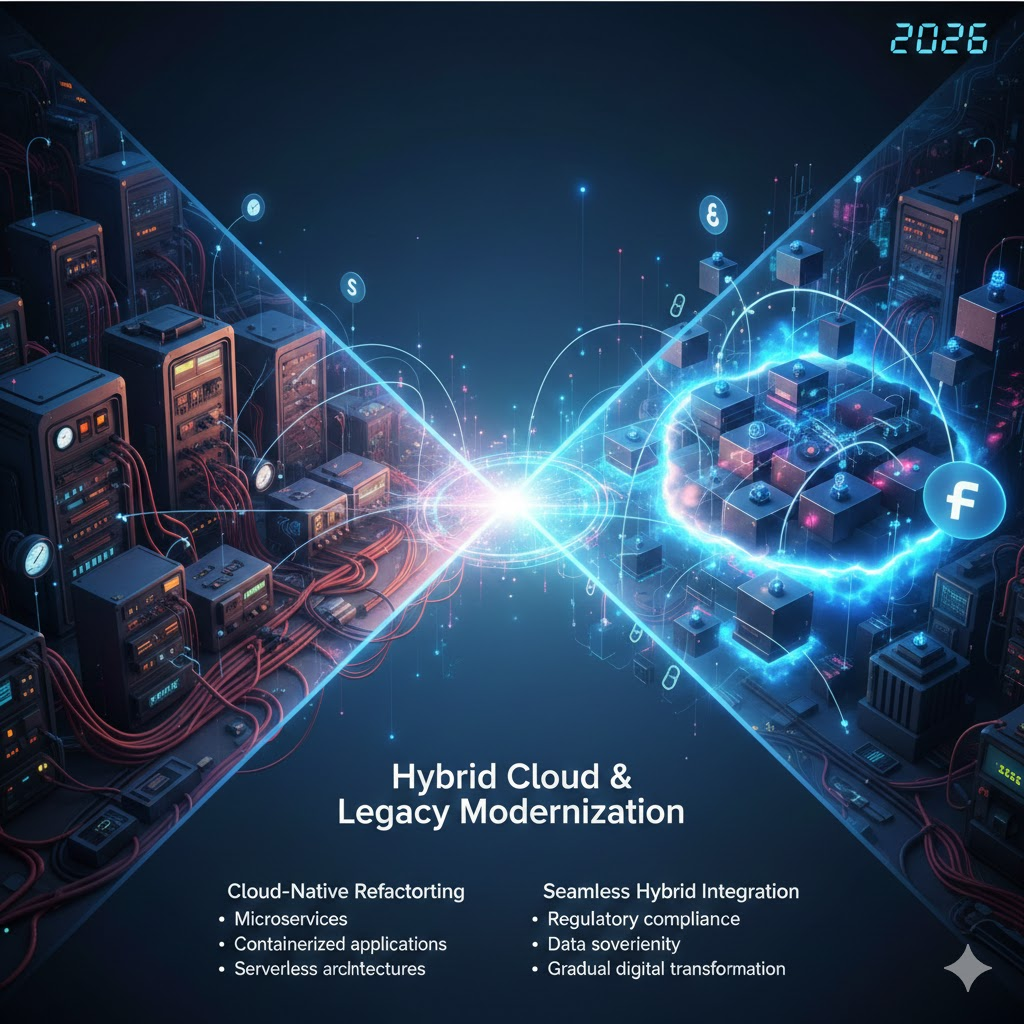
Hybrid Cloud and Legacy Modernization
Many enterprises still operate legacy systems. In 2026, modernization strategies focus on gradual transformation.
Cloud-Native Refactoring
Organizations are refactoring monolithic applications into:
- Microservices
- Containerized applications
- Serverless architectures
This improves scalability and resilience within enterprise cloud infrastructure environments.
Seamless Hybrid Integration
Hybrid cloud remains critical for businesses requiring:
- Regulatory compliance
- Data sovereignty
- Gradual digital transformation
Modern hybrid platforms allow secure integration between on-premises systems and public cloud services.
This shift reflects why hybrid cloud is becoming the standard for modern businesses seeking flexibility and control.
The Rise of Serverless and Containerization
Containerization and serverless computing are reshaping infrastructure management.
Kubernetes Dominance
Kubernetes continues to dominate container orchestration. Enterprises use it to:
- Manage complex microservices
- Scale applications automatically
- Maintain high availability
Kubernetes-based enterprise cloud infrastructure delivers flexibility and efficiency.
Serverless for Event-Driven Architectures
Serverless computing eliminates the need to manage underlying infrastructure. It allows enterprises to:
- Deploy faster
- Reduce operational overhead
- Scale instantly
Event-driven architectures powered by serverless technologies are becoming mainstream.
Data-Centric Cloud Infrastructure
Data is the most valuable enterprise asset. In 2026, enterprise cloud infrastructure is increasingly data-driven.
Unified Data Platforms
Organizations are building centralized data lakes and warehouses that integrate:
- Structured data
- Unstructured data
- Streaming data
These platforms support AI, analytics, and real-time decision-making.
Data Governance and Compliance
Strong governance frameworks ensure:
- Regulatory compliance
- Data privacy protection
- Secure data access controls
Data security is embedded into infrastructure design.
Workforce Transformation and Cloud Skills
Technology alone does not define enterprise cloud infrastructure—people do.
Upskilling IT Teams
Enterprises invest heavily in training programs focused on:
- Cloud architecture
- DevOps practices
- Cybersecurity
- Automation
Cloud expertise is one of the most in-demand skill sets in 2026.
Cloud Center of Excellence (CCoE)
Many organizations establish Cloud Centers of Excellence to:
- Define best practices
- Standardize architecture
- Promote innovation
- Govern cloud usage
These teams drive strategic cloud initiatives across departments.
Industry-Specific Cloud Innovations
Different industries are leveraging enterprise cloud infrastructure in unique ways.
Healthcare
- Secure patient data storage
- AI-driven diagnostics
- Telemedicine platforms
Finance
- Real-time fraud detection
- High-frequency trading systems
- Regulatory compliance automation
Manufacturing
- Smart factories
- Predictive maintenance
- IoT-powered analytics
Each sector customizes its cloud infrastructure to meet specialized requirements.
What Businesses Must Do to Prepare for the Future
To remain competitive in 2026 and beyond, organizations should:
Develop a Clear Cloud Strategy
A successful enterprise cloud infrastructure roadmap includes:
- Defined business objectives
- Security-first design
- Scalability planning
- Cost governance frameworks
Invest in Security and Compliance
Proactive cybersecurity investments prevent costly breaches and regulatory penalties.
Prioritize Flexibility and Scalability
Future-ready cloud environments must adapt quickly to:
- Market changes
- Customer demands
- Technological advancements
The Long-Term Outlook for Enterprise Cloud Infrastructure
Looking ahead, enterprise cloud infrastructure will continue evolving toward:
- Fully autonomous operations
- Quantum-ready security models
- AI-native architectures
- Hyper-distributed global networks
Cloud will become even more intelligent, automated, and deeply embedded into core business processes.
Organizations that embrace innovation, prioritize security, and align cloud strategy with business outcomes will lead their industries.
Conclusion
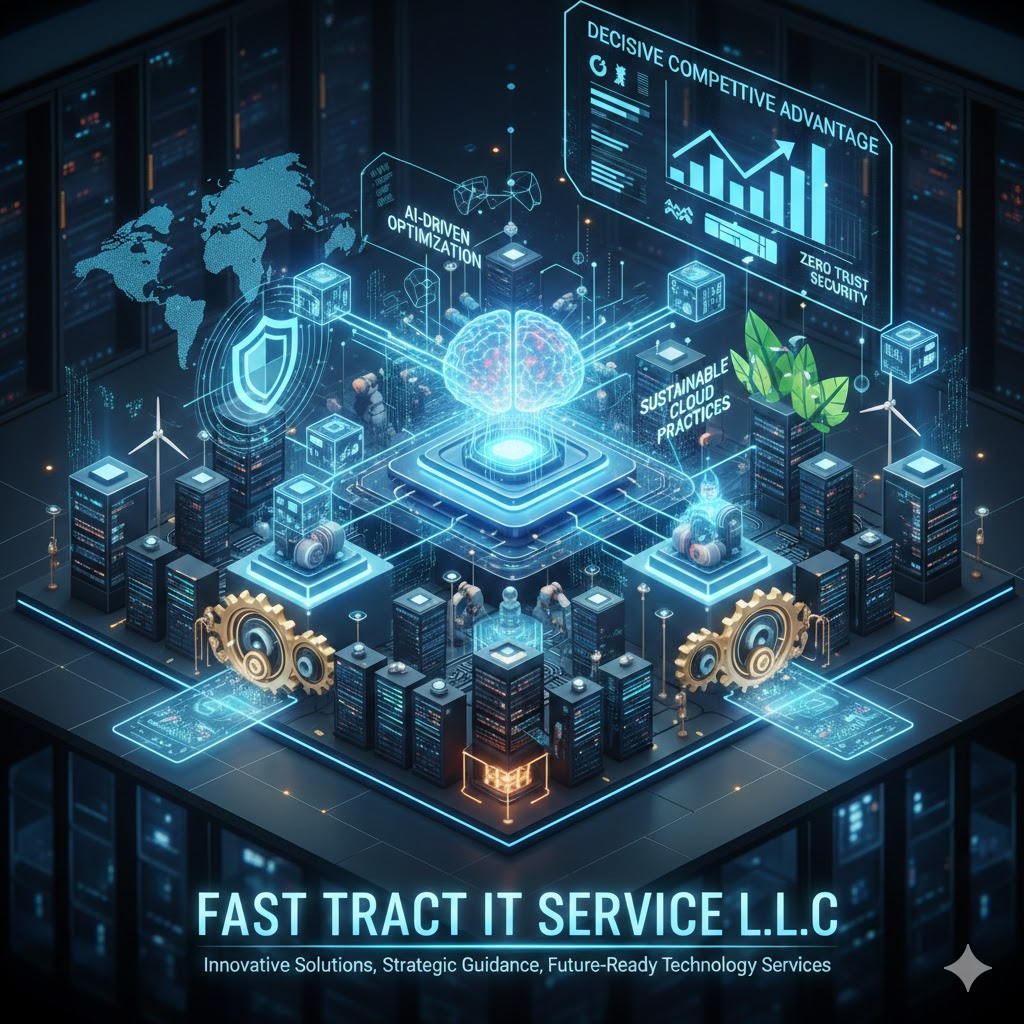
Enterprise cloud infrastructure in 2026 is smarter, more distributed, highly automated, and deeply integrated into every aspect of business operations. From AI-driven optimization and edge computing to Zero Trust security and sustainable cloud practices, the modern cloud environment is both complex and powerful.
Companies that invest strategically in scalable, secure, and efficient enterprise cloud infrastructure will gain a decisive competitive advantage. The future belongs to organizations that treat cloud not just as technology—but as a transformation engine.
FAST TRACT IT SERVICE L.L.C remains committed to helping businesses navigate the evolving landscape of enterprise cloud infrastructure with innovative solutions, strategic guidance, and future-ready technology services.