





FAST TRACT IT SERVICE L.L.C shares expert insight into how organizations can build a future-ready IT strategy for businesses that drives innovation, strengthens security, and supports sustainable growth in 2026 and beyond.
Technology is no longer just a support function—it is the backbone of modern business operations. From cloud computing and AI adoption to cybersecurity and data governance, every strategic initiative depends on a strong IT foundation. In 2026, companies that lack a clear, scalable, and secure IT roadmap risk falling behind competitors who treat technology as a strategic growth enabler.
An effective IT strategy for businesses must go beyond infrastructure planning. It must align with executive objectives, support digital transformation, and proactively manage risk.
Aligning IT Strategy with Business Goals
The most important characteristic of a successful IT strategy is alignment with overall business objectives.
Technology as a Growth Driver
An effective IT strategy for businesses should support:
- Revenue growth initiatives
- Market expansion plans
- Customer experience improvements
- Operational efficiency goals
- Innovation and product development
When IT leaders collaborate closely with executive teams, technology investments directly contribute to measurable business outcomes.
Cloud-First and Hybrid Flexibility
Cloud computing remains central to modern IT strategy.
Scalable Infrastructure Planning
Businesses in 2026 must prioritize:
- Hybrid cloud architectures
- Multi-cloud resilience
- Elastic resource scaling
- Cost optimization frameworks
Cloud environments provide flexibility, but without governance, they can create inefficiencies. A structured IT strategy for businesses ensures scalability without sacrificing control.

Cybersecurity as a Strategic Pillar
Cyber threats continue evolving in sophistication and frequency.
Zero Trust Implementation
An effective IT strategy in 2026 integrates:
- Zero Trust security models
- Multi-factor authentication (MFA)
- Continuous monitoring systems
- Endpoint detection and response (EDR)
Security must be embedded at every level of infrastructure.
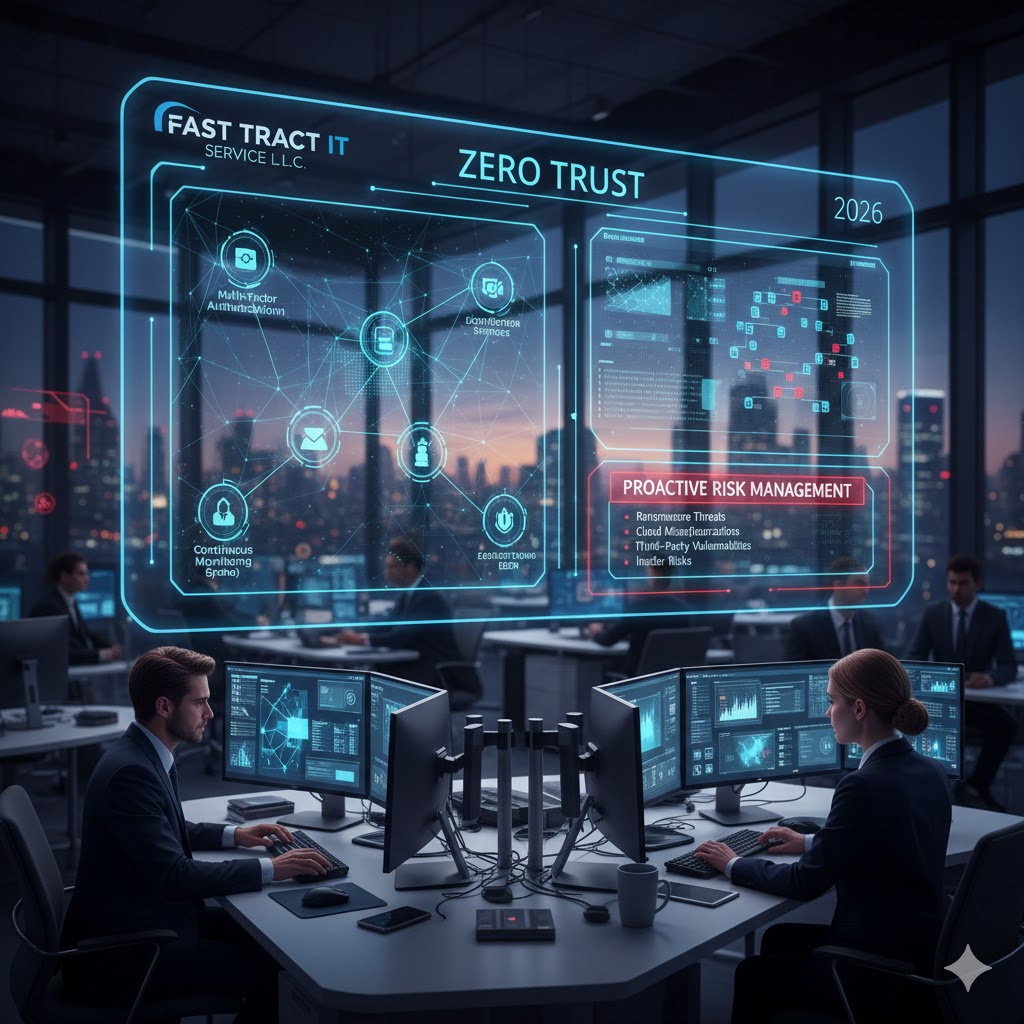
Proactive Risk Management
Modern IT strategy requires ongoing risk assessment to address:
- Ransomware threats
- Cloud misconfigurations
- Third-party vulnerabilities
- Insider risks
Cyber resilience protects operational continuity and brand reputation.
Data-Centric Decision-Making
Data has become one of the most valuable enterprise assets.
Unified Data Governance
An effective IT strategy for businesses must include:
- Centralized data platforms
- Data classification policies
- Compliance monitoring
- Secure storage solutions
Reliable data access improves executive decision-making and strategic forecasting.
AI and Advanced Analytics Integration
In 2026, competitive advantage increasingly depends on AI-powered insights.
Organizations should design IT infrastructure capable of:
- Supporting machine learning models
- Handling large-scale data processing
- Maintaining secure AI pipelines
Technology readiness ensures innovation remains sustainable.

Automation and Operational Efficiency
Automation reduces operational complexity and human error.
Infrastructure as Code (IaC)
Leading organizations deploy:
- Automated provisioning tools
- Standardized configuration management
- Continuous integration and deployment (CI/CD) pipelines
Automation enhances agility and scalability.
IT Service Management (ITSM) Modernization
Modern IT strategy also prioritizes:
- Automated service ticketing
- Self-service portals
- Predictive maintenance tools
Efficiency gains reduce costs and improve user satisfaction.
Workforce Enablement and Remote Readiness
The modern workforce is increasingly hybrid and distributed.
Secure Remote Access
An effective IT strategy for businesses includes:
- Secure VPN alternatives
- Cloud-based collaboration tools
- Identity and access management systems
Flexibility enhances productivity while maintaining security.
Upskilling and IT Talent Development
Technology evolves rapidly. Organizations must invest in:
- Continuous training programs
- Cloud certifications
- Cybersecurity awareness education
Skilled teams drive successful strategy execution.
Cost Governance and Financial Transparency
Technology spending continues to rise. Financial oversight is essential.
FinOps and Cost Optimization
An effective IT strategy for businesses integrates:
- Real-time cost monitoring
- Budget forecasting
- Resource optimization
Aligning spending with performance metrics ensures maximum ROI and reinforces the importance of aligning IT investment with broader business objectives to drive measurable strategic outcomes.
Resilience and Business Continuity
Downtime and disruptions can derail growth plans.
Disaster Recovery Planning
A future-ready IT strategy includes:
- Clearly defined recovery time objectives (RTO)
- Automated backup systems
- Redundant infrastructure design
Resilience supports long-term stability.
Incident Response Preparedness
Organizations must maintain:
- Documented response procedures
- Crisis communication protocols
- Regular security testing
Preparedness reduces operational and reputational damage.
Governance and Compliance Frameworks
Regulatory complexity continues increasing globally.
Compliance Integration
An effective IT strategy for businesses ensures:
- Continuous regulatory monitoring
- Automated compliance reporting
- Audit-ready documentation
Governance strengthens stakeholder confidence.
Sustainable and Green IT Practices
Sustainability has become a strategic priority.
Energy-Efficient Infrastructure
Organizations are adopting:
- Cloud providers using renewable energy
- Efficient hardware systems
- Resource optimization policies
Sustainable IT aligns with corporate responsibility goals.
Continuous Strategy Evaluation
An IT strategy cannot remain static.
Ongoing Performance Review
Leaders should evaluate:
- Infrastructure performance
- Security metrics
- Cost efficiency
- Technology adoption outcomes
Regular reviews allow adjustments as market conditions evolve.
Common Mistakes to Avoid
Even strong organizations can struggle with IT strategy implementation.
Siloed Decision-Making
Lack of cross-department collaboration weakens strategic alignment.
Reactive Planning
Waiting for problems before investing in solutions increases long-term risk.
Underestimating Security Investment
Treating cybersecurity as optional exposes organizations to major financial and reputational consequences.
The Future of IT Strategy for Businesses
Looking ahead, effective IT strategies will increasingly focus on:
- AI-native infrastructure
- Autonomous IT operations
- Advanced threat intelligence integration
- Hyper-distributed cloud environments
- Quantum-resistant encryption
Organizations that adapt early will gain competitive advantages.

Conclusion
An effective IT strategy for businesses in 2026 is comprehensive, scalable, secure, and aligned with executive priorities. It integrates cloud flexibility, cybersecurity resilience, automation, data governance, and cost management into a unified roadmap.
Technology is no longer a support function—it is a strategic growth engine. Companies that treat IT as a core business driver will innovate faster, respond to risk more effectively, and maintain long-term competitiveness.
FAST TRACT IT SERVICE L.L.C partners with organizations to design and implement forward-looking IT strategy for businesses that align technology investments with executive objectives, ensuring secure, scalable, and future-ready growth.